The Man
A financier, politician, writer, and collector, a citizen of Spain and a Catalan nationalist, Francisco de Asís Cambó i Batlle was born in Vergés, a small town in Girona, on September 2, 1873. From a modest family, after finishing his studies he went to Barcelona where he found work in a pharmacy. During this time, he combined his studies with work. He earned his high school diploma and later became a lawyer.
He began his political career at the age of 19, became a city councilor at 24, and a member of parliament at 29, always representing the conservative-inspired Catalan nationalist party, the Lliga Regionalista, of which he was the undisputed leader from 1917. He served as Minister of Public Works (1918) and Minister of Finance (1921-1922) in two governments under Antonio Maura. He was again elected to parliament in the second legislature of the Republic in 1933. [1]
From 1920, he worked for the Spanish company CHADE (Compañía Hispano-Argentina de Electricidad), which supplied electricity to Greater Buenos Aires and belonged to a conglomerate of the German AEG electrical holding company. At its headquarters in Barcelona, he established an economic and legal office. He served as vice president of the board of directors until 1926 and then as president until his death in 1947. He became a member of the board of directors of 19 German, French, Belgian, Swedish, Spanish, Argentine, Uruguayan, and Mexican companies, most of them electrical [2].
Cultural Endeavors
During the 1920s, while remaining removed from the political scene, Cambó promoted the creation of several institutions dedicated to disseminating studies on Catalan culture and language: the Fundació Bernat Metge, for the translation of major works of the Greek and Latin classics into Catalan, overseen by a group of renowned philologists; The Catalan Biblical Foundation, dedicated to the translation of the Bible into Catalan by an exceptional team of experts; the Hebraic-Catalan Foundation, which was responsible for the translation of Hebrew works; and Alpha Publishing House, with the aim of disseminating Catalan studies. It also promoted the publication of Monumento Cataloniae, a series of exceptional volumes on the various facets of monumental art in Catalonia.
Formation of the Collection
Between 1922 and 1936, by purchasing works by great masters, Cambó amassed an exceptional private art collection, which became the second largest in Spain after that of the Duke of Alba. Conceived with the clear intention of donating it, after his death, part of the collection went to the Prado Museum in Madrid to fill some of its gaps, particularly in Italian paintings from the Trecento and Quattrocento periods, and the other part to the Barcelona Museum to provide it with Renaissance paintings, in which the public collection was lacking.
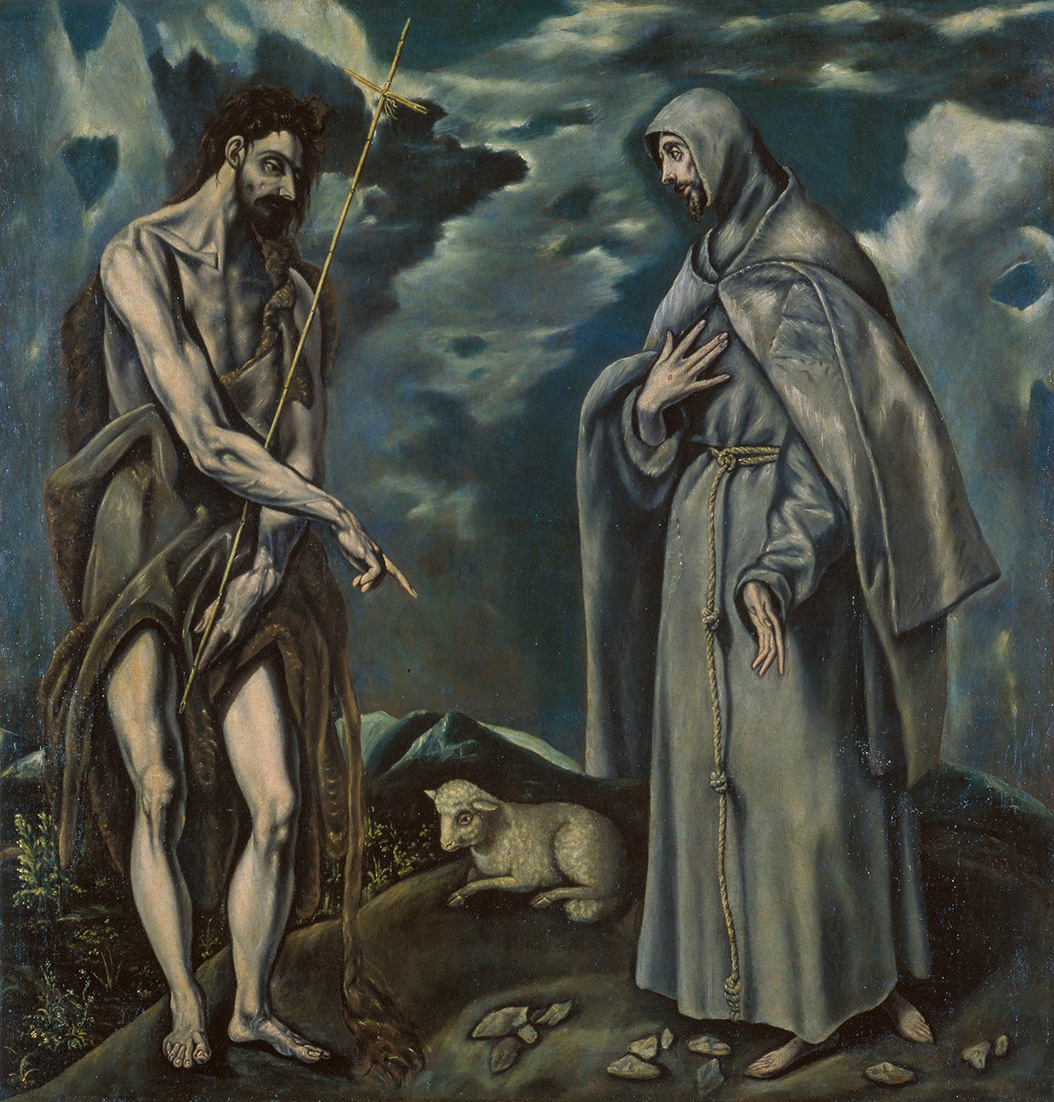
He acquired Italian, French, Flemish, and Spanish paintings from the 13th to the 17th centuries. These included works by Botticelli, Tintoretto, Fra Angelico, Veronese, Correggio, Lippi, Titian, Tiepolo, Raphael, Rubens, Cranach, Gainsborough, and Van Dyck. Quentin de La Tour, Fragonard, El Greco, Murillo, Zurbarán, Velázquez, and Goya—he invested a good part of his fortune in acquiring them.
A significant portion of his collection came from a 1929 purchase of the collection assembled in Paris by the painter George Spiridon, who had acquired paintings in Italy from Cardinal Fesch's collection. This collection was inherited and expanded by his sons, Ludovico and Joseph Spiridon. The portion inherited by Ludovico, based in Rome, was auctioned in Amsterdam in 1928. Joseph's collection (1845–1930), more significant than his brother's, focused on early Italian painting, including notable examples of 14th- and 15th-century Tuscan art. It was displayed in his home on the rue Ballu in Paris, where he amassed 79 works. It was considered among the finest private collections of Italian painting, and many pieces were well-known thanks to art history literature. After lengthy negotiations, and with the collaboration of various experts and art dealers, Cambó purchased the entire collection with the intention of auctioning it, reserving for himself the pieces that interested him.
In his posthumously published Memoirs, Cambó reveals the behind-the-scenes details of his acquisition: “Mr. Spiridon had received tempting offers to buy pieces from his collection. He had always rejected them: he could sell the entire collection, but he didn't want to lower the price by removing any of the best pieces. And buying the whole collection meant a very considerable outlay. I visited the Spiridon collection, horribly displayed, and there I found almost everything in early Italian painting that could interest me. Spiridon's decision not to sell individual pieces made it impossible for me to make any acquisitions. After much deliberation, I realized that if I decided to take a risk, I could achieve my goal: to come to an agreement with a trusted art dealer to buy the entire collection, and then hold a public sale in which I would acquire the paintings that interested me. Carrying out the plan was no easy task.”
He then details his subsequent steps: “First, to minimize risk, I needed an appraisal from competent and honest experts and dealers; then, a dealer had to negotiate with Mr. Spiridon. Once the collection was purchased, it had to be moved to the city where a public sale offered the greatest chance of success, and finally, the catalog had to be produced, and the international advertisement prepared to attract the participation of major dealers, major collectors, and leading museums worldwide, especially in the Americas. And all of this had to be done without anyone suspecting that I was the buyer.”
He recounts how he closed the deal with Spiridon: “Fortunately, thanks to a flawless organization that amused me as much as running a political campaign, the entire plan was executed perfectly. The negotiation with Mr. Spiridon was very long and difficult: one minute it seemed we had reached an agreement, the next it seemed there was no hope at all… Finally, he decided to sign, and he did!” The price to be paid was high and had to be paid immediately. I did not have the necessary sum in cash, and it was necessary to request a substantial line of credit from a bank.” He then explains his intention: “My purpose was to auction the Spiridon collection, keeping for myself the works I desired. Naturally, since the sale was being conducted by me, I could raise the prices of the selected works to figures unattainable for others, or simply withdraw them from the sale.” He then describes the procedure: “The purchase was made in the names of two major art dealers, one Swiss and the other German. At that time, Berlin was the largest art market in Europe because the best painting experts resided there. Therefore, once the dealers had established their agreement with Joseph Spiridon, and vice versa, the paintings were transported to Berlin, where, with the formidable documentation available there and with the assistance of the best experts, the auction catalog was prepared [...].”
He then goes on to detail the auction held in Berlin on March 31, 1929: “Representatives of the world’s leading art dealers and a good number of museums and major American private collections attended the sale; I went with a mixture of interest and trepidation. In these sales, one can never know what will happen [...] Thus, the sale opened in the grand ballroom of the Explanade Hotel, packed to capacity, without us being able to know whether we were headed for a brilliant success, which would give me the works I wanted at a good price, or whether the sale would be a disaster and I would suffer a considerable loss. I had marked in the catalog the price at which we had estimated each painting when we made the purchase. From the first moment, I saw that the prices at which the paintings were sold almost always exceeded our estimates. This encouraged me to further expand the purchases I had already decided upon. I made none of the acquisitions directly. I had distributed the commissions among different dealers who did not know each other.” Each of them knew they were buying for me, but they didn't know anyone else was buying. When the sale was over, no one knew I had been the main buyer [3].
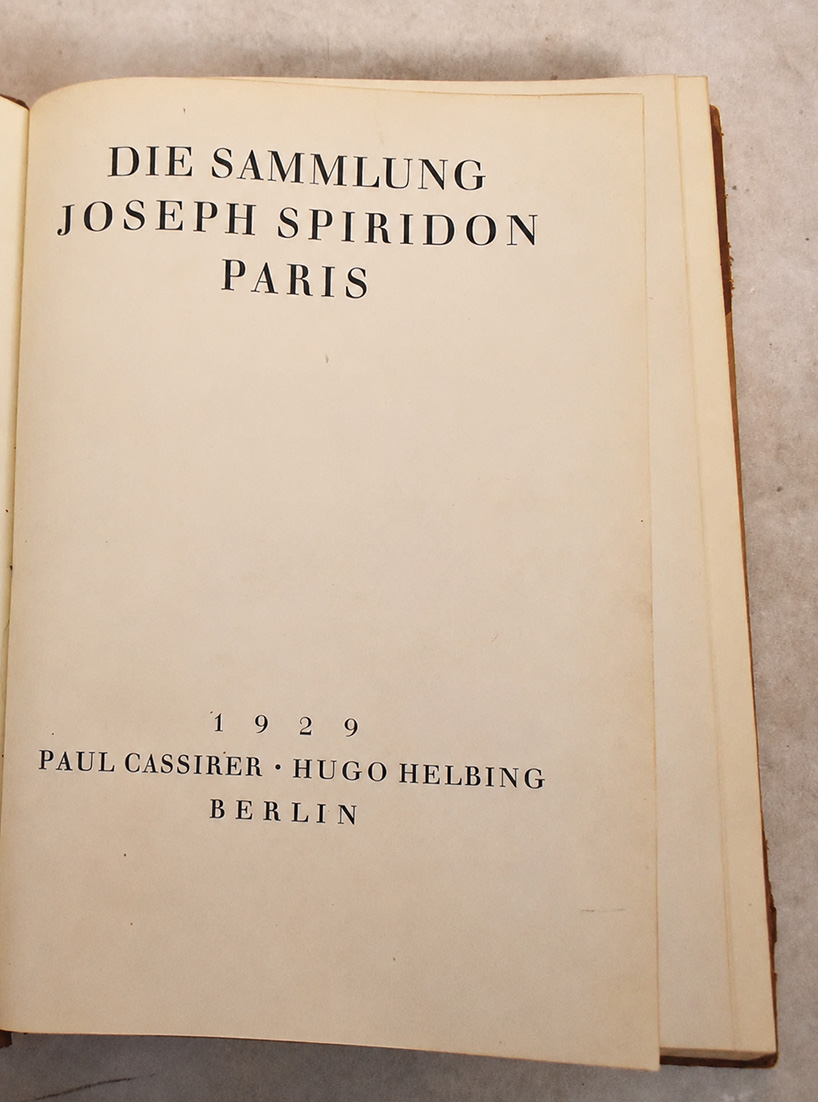
The catalogue mentioned by Cambó was luxurious, illustrated, and a limited edition [4].
It should be added that of the 79 works that made up the Spiridon collection, Cambó managed to acquire 27, including most of those that would later form part of his donation to the Prado Museum.
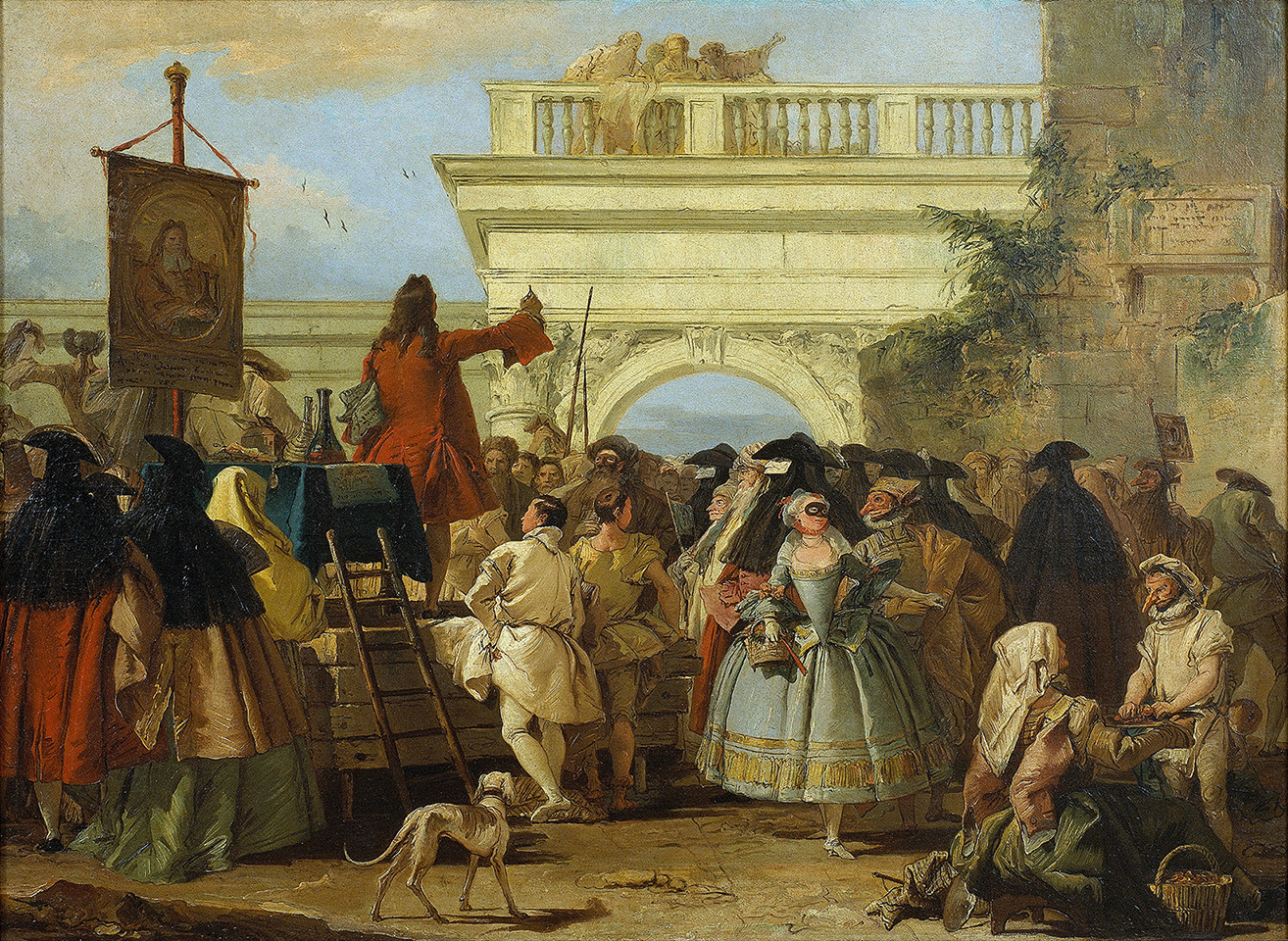
In addition to the Spiridon collection, Cambó acquired Tiepolo's The Charlatan and The Minuet that same year, which had been part of the collection belonging to Prince Papadoppoli. As fate would have it, one of the prince's executors was Count Volpi, a close friend of Cambó, who, when asked if those paintings would be for sale, said yes, as long as the sale was discreet, as the widowed princess requested. Mussolini had said that the collection would not leave Italy. But, determined to get his way, Cambó appealed to the Count of Viñaza, the Spanish ambassador in Rome, arranging for the Minister of Finance to authorize the sale of the painting in exchange for the State being able to collect the substantial inheritance taxes owed, plus a separate sum for the young widowed princess and her three daughters, so that they could buy clothes in Paris! This cleared the way for the paintings to leave [5]. Another of his acquisitions was a portrait by Murillo [now attributed to Claudio Coello] from the Holford Collection, one of the most important private art collections in England during the 19th and 20th centuries [6].
The collection gradually took its final form [7], dispersed throughout various spaces on the top two floors of the building he commissioned between 1921 and 1925 at number 30 Via Laietana in Barcelona, designed by the architect Adolf Florensa i Ferrer. The seventh floor was designated for offices and the eighth for the family residence. He decided not to live on the main floor, but rather in the attic and the upper attic, each 800 square meters, and even commissioned the renowned French architect Jean-Claude Forestier to design a small garden in the latter. There he had panels depicting scenes from the Decameron and the splendid portrait of Michelle Marullo [perhaps the finest portrait of the Italian Quattrocento] painted by Sandro Botticelli. He often spent his evenings reading Plutarch or Livy. A passionate car enthusiast [at the time of his death he owned two Rolls Royces, a Packard, and an Austin], he had sailed up the Nile to Abu Simbel aboard his yacht, the "Catalonia."
In Buenos Aires
The Spanish Civil War caught Cambó abroad, but he was able to gather his scattered paintings in Switzerland, except for those that remained at the Prado Museum for restoration: the Titian, the Sebastiano del Piombo, the Correggio, and the El Greco. He knew nothing of a portrait of a bearded man with a hat, probably by Franz Hals, nor of a child by the same great painter, nor of a panel by Brouwer depicting a popular scene. Living in Montreux with his family, collaborators, and staff, after the Civil War ended, witnessing the daily brutality of Franco's regime and the suffering of his friends and colleagues, despite his efforts on behalf of the cause, he decided not to return to Spain. In May 1940, the German armies invaded the Netherlands and Belgium and occupied France. In July, Cambó left Switzerland by plane, spent a few days in Barcelona and Madrid—where he presided over a meeting of the CHADE (Spanish Association of Art and Design)—and then traveled to Portugal, staying in Estoril. At the beginning of August, they boarded the Excalibur bound for New York, where they resided, and in 1941 he settled in Buenos Aires [8].
Cambó knew that his work as a collector was finished and that what he had not yet accomplished in terms of selection and refinement, he could never do again. Thus, on April 21, 1941, he wrote to Sánchez Cantón, then deputy director of the Prado Museum: “My intention is to donate a good part of my collection, certainly my Italian primitives, to the Prado Museum. I would be willing to begin fulfilling my intention now if I could obtain permission to have some of the paintings I have in Spain with me while I am in America.” The proposal that occurs to me is this: I would, of course, give the Prado my painting by Giovanni da Ponte, my three large Botticelli panels, two primitive paintings generally attributed to Taddeo Gaddi, and by many critics, including Berenson, to Pietro Nelli, and the fresco by Melozzo da Forlì. I would, from now on, cede these paintings to the Museum, reserving the right—which I probably would not exercise—to keep the Botticelli panels, the Taddeo Gaddi paintings, and the Melozzo fresco in my home and company when I reside in Spain and for the rest of my life; the Giovanni da Ponte would no longer leave the Prado, where it could make a magnificent pendant to the Fra Angelico.”
Although some attributions and dates have been modified in light of later studies, these are generally good examples of early Renaissance Italian painting, of which there was no representation in the Prado.
Giovanni da Ponte's work was a panel depicting The Seven Liberal Arts, originally intended to decorate a Florentine cassone; it probably belonged to the Toscanelli collection [Pisa], from which it passed to the collection of the Prince of Villa Franca, from where it was acquired in 1898 by Joseph Spiridon.
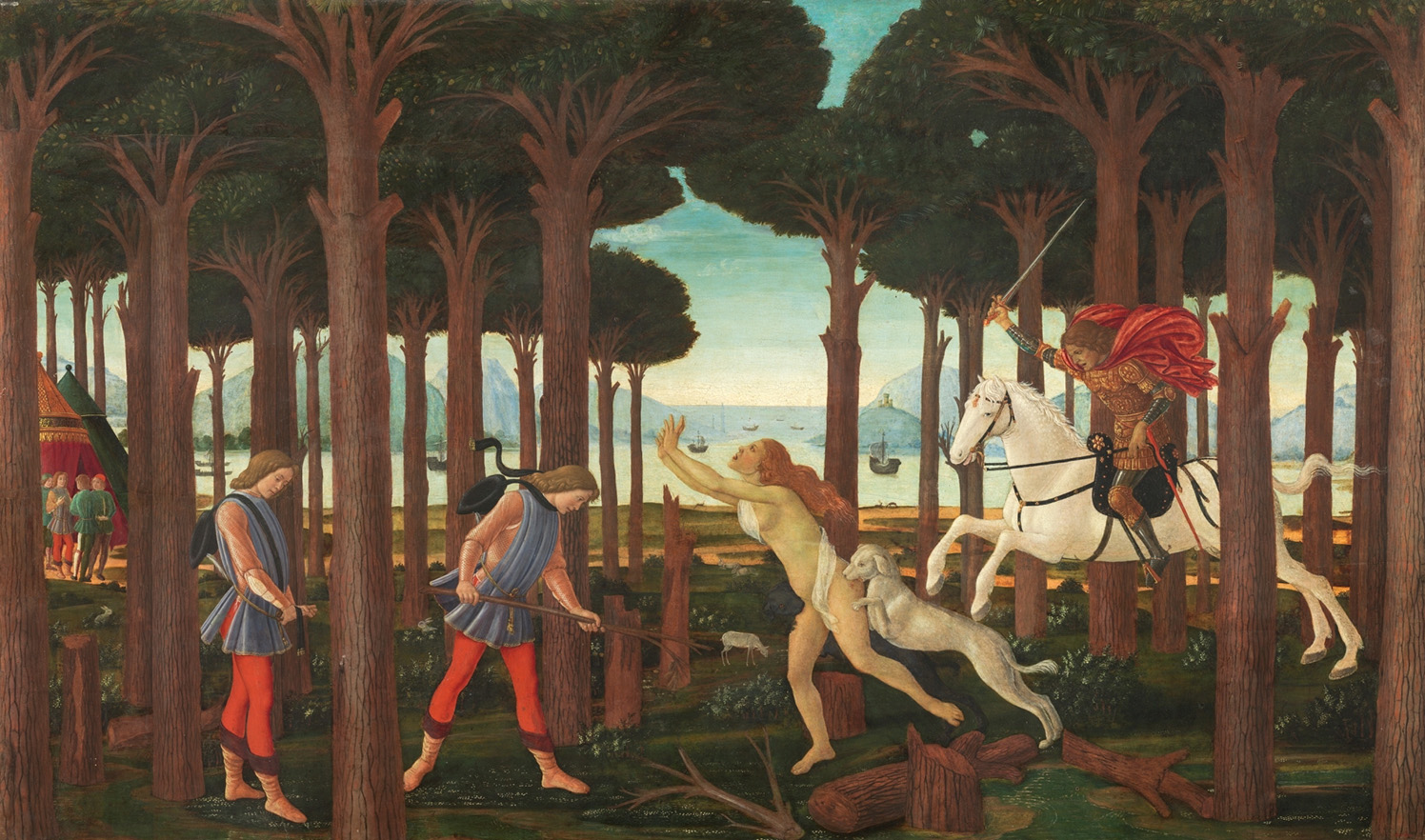
The "three great panels by Botticelli" are the first three of the four paintings commissioned from the artist in 1483 to commemorate the marriage of two members of Florentine families. They depict the story of Nastagio degli Onesti, as told by Boccaccio in the Decameron. The complete series was acquired by Alexander Barker in 1868 from the Pucci family of Florence, for whom they were painted. Upon Barker's death in 1879, they passed into the I. R. Reyland collection, and in 1892 they were purchased by the Frenchman Gustave Aynard, a member of parliament for the Rhône department, who sold three to Joseph Spiridon and the fourth to Vernon Watney.
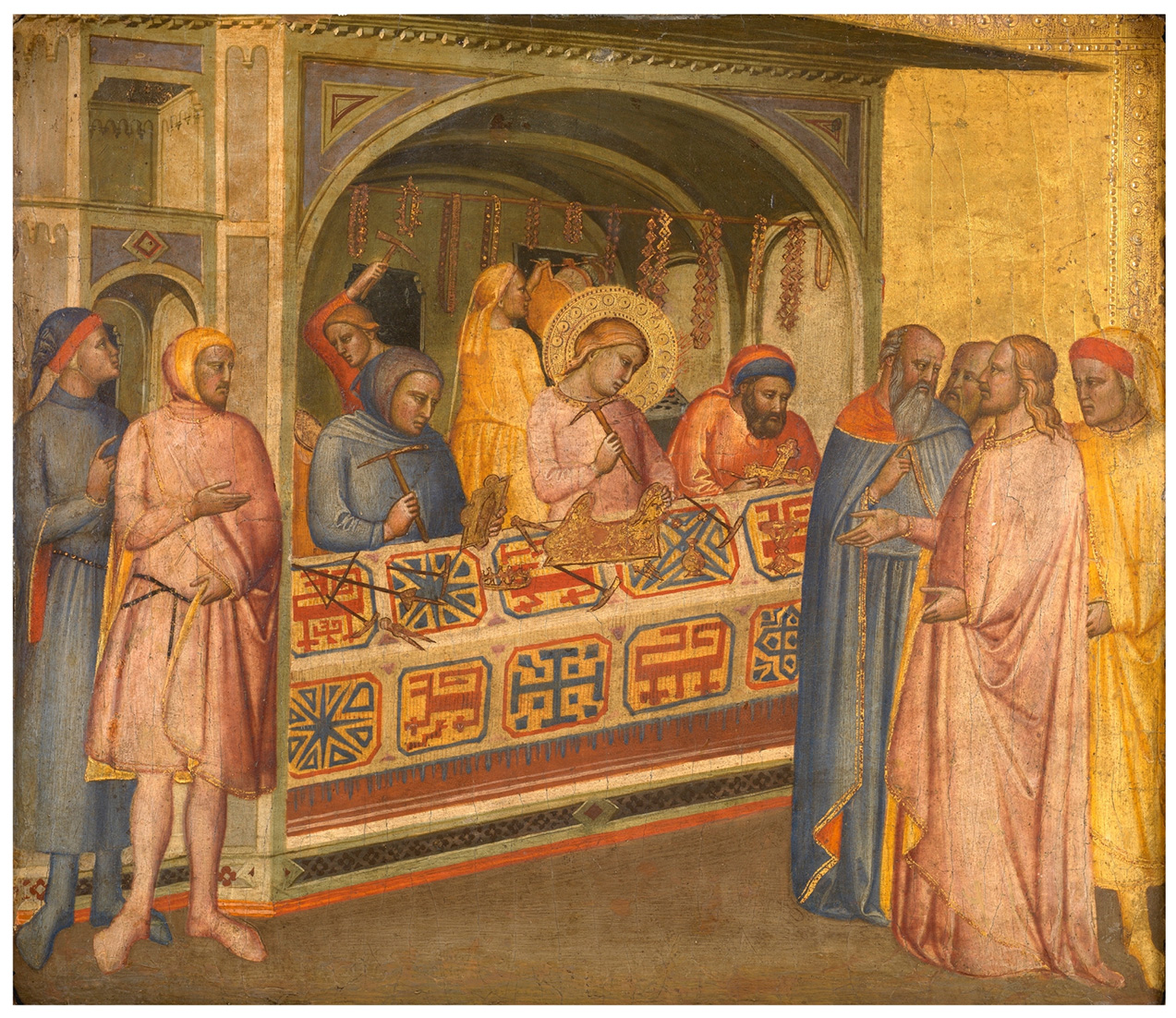
Regarding the two panels that Cambó attributed to Taddeo Gaddi, Saint Eligius in the Goldsmith's Workshop and Saint Eligius before King Clotaire, these are the ones currently considered to be by the Master of the Madonna of Mercy. They belonged to the Toscanelli collection [Pisa]. Joseph Spiridon acquired them in 1898. The series includes a third work [The Funeral of Saint Eligius] in the Drey collection, Munich.
Finally, the work attributed to Melozzo da Forlì, a fresco currently considered a late copy, depicts a Musical Angel or Imitation of Christ. In 1904, it belonged to Simonetti [Rome], from whom Joseph Spiridon acquired it.
The Museum's Board of Trustees formally accepted and thanked Francisco Cambó for his generosity at a meeting held on May 5, 1941 [9].
Before initiating the procedures in Spain for the transfer of his paintings, Cambó, with all due caution and care, through his representative, Rafael Vehils, addressed the National Commission of Museums and Historical Monuments of the Ministry of Justice and Public Instruction of the Argentine Nation [the only jurisdictional body competent to resolve according to the Law that created it, number 12,665 of October 8, 1940], in a consultation formulated on November 29, 1941, to which the president of the Commission, Dr. Ricardo Levene, responded, anticipating his personal opinion, which was confirmed by the opinion of the full Commission which, on December 22, stated: "The members of the Subcommittee on Museums who subscribe to this document have taken into account the consultation formulated by Mr. Rafael Vehils, regarding the situation in which a collection of paintings, which includes canvases by famous painters, would find itself with respect to the provisions of Law 12,665." and that their owner intends to bring them into the country, "In the case of paintings originating from abroad, with the knowledge of this National Commission, we believe that they should not be subject to the provisions of Article 5 of the Law nor to the regulations that complement it."
For its part, the Spanish General Directorate of Customs, on December 9, 1941, communicated the following to the Bilbao Customs Office: "Having been authorized by the Council of Ministers, as communicated to this office by the General Directorate of Fine Arts in Order dated the 8th of this month from the Ministry of National Education, please allow the temporary export to Buenos Aires, destined for Mr. Francisco Cambó, of the paintings detailed below: Portrait of Vicente Morosini, by Tintoretto.
-Portrait of Notary Laideguive, by Quintin Latour.
-Portrait of Lady Thomas Arundell, by Rubens.
-Portrait of Lady Spencer, by Gainsborough.
-Portrait of a Black Man, by Benjamín Cuyp."
-Portrait of a Woman, by Sebastiano del Piombo.
-Portrait of Laura Dianti, by Titian.
-Eve, by Correggio.

Portrait of Pierre-Louis Laideguive, pastel on paper by Maurice-Quentin de La Tour [1704-1788], held in the National Art Museum of Catalonia. One of the paintings that Asís Cambó enjoyed in Buenos Aires.
The aforementioned paintings will be documented with a duty-free export invoice, which will detail the paintings in question, stating that it is issued to serve as proof of shipment upon the return to Spain of the items to which it refers, which will be shipped on the CAODE HORNOS.
These eight paintings were joined, following the same procedures, in July 1946, by Goya's Cupid and Psyche.
At that time, arrangements were made to send to Spain those paintings that Cambó was donating to the Prado Museum and which had remained in Switzerland. The paintings arrived at the Museum on January 18, 1942, and were exhibited to the public in the Italian painting galleries on February 27 of the same year.
The paintings, which had arrived in Buenos Aires from Spain, were installed by Cambó on the spacious second floor of the building at 4654 Avenida Alvear, which was his residence. This building, now demolished, is located at what would now be 3754 Avenida del Libertador, between Sinclair and Godoy Cruz streets, across from Plaza Holanda. The paintings were also displayed at his estate, Mon Repós, in the heart of San Miguel, a two-story house with white walls, red tiles, and a colonial style with Andalusian touches.
Cambó built another library here, to the point that the writer Luis Horacio Velázquez, who went on to preside over the Commission for the Protection of Public Libraries, recalls that from the time he settled in Buenos Aires, "he dedicated himself to acquiring books and documents about the Spanish conquest and colonization of America, managing to assemble a splendid bibliography on the subject" [10].
Fate of the Collection
Francisco Cambó died on April 30, 1947. The newspaper La Nación commemorated the deceased's dedicated work [11]. His remains were laid in state at his home on what was then Avenida Alvear, and after a brief stop at the San Agustín parish, were buried in the Cementerio del Norte (North Cemetery).
In his final will, drawn up in Buenos Aires on November 4, 1946, he bequeathed the remainder of his paintings to Barcelona, having already disposed of the others during his lifetime. His late marriage to Mercé Mallol shortly before his death in 1946, and the acknowledgment of his daughter Helena, allowed him to designate her as his sole heir. In his testamentary dispositions, he stipulated that his daughter and heir could choose a single work from the collection, as a testament to and remembrance of the collection, under normal circumstances. Only in the event—which occurred—of a decrease in the value of the estate, did he grant her the right to retain and sell as many works as she wished, a right Helena Cambó waived so as not to frustrate or diminish her father's wishes, hopes, and endeavors. The probate proceedings began in Buenos Aires, and the will was approved on February 28, 1950.
The Barcelona City Council appeared, submitting the Notarial Deed by which it accepted the bequest. The General Directorate of Taxation assessed the tax and set the rate for non-residents, with a surcharge for the beneficiary's absence. The transfer of funds for tax payment was carried out with the intervention of the Spanish Foreign Exchange Institute and the Central Bank of the Argentine Republic, and received in accordance with the law by the Tax Authority.
However, when the representatives of the Barcelona Museum requested the release of the paintings, which were held in judicial custody, Decree 1298 of June 26, 1952, was unexpectedly issued, signed by President Perón and his Ministers of Justice and Education. The decree invoked the protection of the rights of workers, families, the elderly, education, and culture, enshrined in the National Constitution, and argued that the execution of the bequest should be prevented because it would diminish the country's cultural heritage and constitute "a clear breach of the protective mission that the aforementioned constitutional provision has conferred upon the powers of the State in this area of spiritual interests." Then Mr. Juan Zocchi, a journalist and art critic appointed director of the National Museum of Fine Arts in Buenos Aires, taking advantage of the fact that Article 3 of the Decree stated that the relevant authorities would adopt the necessary measures to prevent the paintings from leaving the country, urged the Judge to appoint him as custodian of the paintings. He obtained this by order of July 24, 1952, which was appealed by the Barcelona City Council, Cambón's daughter and heir, his widow, and his executors.
A contentious appeal was filed. Guardans y Vallés, Cambón's son-in-law, traveled to Buenos Aires where he learned of the unsuccessful appeals of Manuel Aznar y Zubigaray, the Spanish ambassador, who conveyed his opinion to the Minister of Foreign Affairs, Martín Artajo: "The magnificent audacity with which things are done in this country led the Government and the Judge to adopt the decisions that provoked our immediate reaction." Suddenly, they tried to resolve a problem that has no solution other than the law and decorum. Suddenly, the Executive Decree appeared, prohibiting the removal of the paintings. Suddenly, the Judge signed the order mandating their return to the Museum; and suddenly, finally, the expropriation proceedings were initiated. Now, the Judge is quite astonished by the Spanish protest, because he claims he assumed everyone was in agreement, including the Spanish Government, the Argentine Government, the heirs, the executors, and the Barcelona City Council. And he doesn't know how to get out of this impasse.
Meetings with Foreign Minister Remorino, Undersecretary Amaya, and the Director of the Western Europe division, Piaggio, proved fruitless, but Aznar, without being told, realized that the matter was directly in the hands of President Perón, "and the decision is subject to his direct and personal consideration."
Guardáns—the collector's son-in-law—returned to Spain, where he was immediately received by the Generalissimo and gave him a reasoned explanation of the measure that had undermined legal certainty. Then, "Francisco Franco told me to stop worrying altogether because he was taking the matter directly into his own hands. The next day, such precise and urgent orders were issued to Ambassador Aznar that he, surprised, asked Minister Artajo to transcribe the Council of Ministers' agreement verbatim. Martín Artajo replied tersely that the Council did not keep a Book of Minutes [...]". The pressure must have been so great that Perón repealed the Decree with another of three lines that rendered it ineffective "The circumstances that motivated it having changed [...]" and the court-ordered provisional deposit measures were left without legal basis.
Fear of some further arbitrary action prompted the nine paintings to be moved from the Cambó family home to the Spanish Embassy with the utmost secrecy. A qualified representative from the Barcelona Museum went there to pack them. From there, they were hidden inside the furniture and household goods of the recently deceased Minister-Counselor Fermín López Roberts, Marquis of Torrehermosa, and loaded onto the "Cabo de Hornos," which arrived in the port of Barcelona on December 21, 1954. Officially, the ship was carrying the personal effects of the Marquis of Torrehermosa.
The two lift vans left the port for the Montjuïc Museum, preceded and followed by a caravan of cars and surrounded by motorcyclists from the Barcelona Municipal Police. What happened next is well-known history.
Coda
A multifaceted and fascinating figure, Cambó is remembered for his donations of works of art and for the cultural institutions he promoted. He was a professional in both politics and collecting, and he knew all the secrets of the trade and the tricks of the trade. His lean frame, his ascetic face with its thick beard, and his feverish, penetrating eyes, made him resemble one of those gentlemen immortalized by El Greco's brush in his painting The Burial of the Count of Orgaz. He managed to encapsulate his dual role as politician and collector of famous works of art in a memorable phrase: "In politics, nuances are more important than in painting."
He didn't cling too passionately to any one ideology. He didn't belong to the anarchist Catalonia, ready to throw bombs, but rather to the formal, contemplative, serious, and grave Catalonia. He was neither a separatist nor a die-hard Spanish nationalist. Attacked equally by the left and the right, he didn't join either the People's Republic or Franco's regime. While remaining a Catalan nationalist, he always thought big, envisioning a Spain under the single red and yellow flag.
Grades
1] Joseph Pla, Francesc Cambó: materials per una història d'aquests últims anys. Barcelona. Catalonia Bookstore. 1929. Borja de Riquer, Regionalist League. The Catalan bourgeoisie and nationalism [1898-1904], Barcelona, Edicions 62, 1979 and Regionalistes i nacionalistes [1898-1931], Barcelona, Dopesa. 1979. Jordi Casassas Ymbert, Francesc «Cambó i el discurs polític del regeneracionisme català», in El pensament polític català: del segle XVIII a mitjan segle XX, Barcelona, Edicions 62, 1988, p. 205-248. Jesús Pabón, Cambó, 1876-1947, Barcelona, Alpha. 1999. Enric Ucelay Da Cal, Catalan imperialism. Prat de la Riba, Cambó, d'Ors and the moral conquest of Spain, Barcelona. Edhasa, 2003. Josep Termes Ardévol, "From the September Revolution to the end of the Civil War [1868-1939]", in Vol VI of the History of Catalonia, work directed by Pierre Vilar, Barcelona. Editions 62, 1989. p. 9-13 and 158-383.
2] On these activities of his, see Borja de Riquer i Permanyer, Francesc Cambó, home de negocis i empresari cultural, Mataró, Caixa Laietana, 2005.
3] Francesc Cambó, Memóries [1876-1936], Barcelona, Alpha, 1981. There is a Spanish edition by Alianza, Madrid, 1987, and a Catalan paperback edition, published in Barcelona by Ed. Alpha Grup 62, in 2008.
4] Sammlung Joseph Spiridon, Paris. 1 vol. of [86] leaves and 97 plates, illustrations, in octavo. Contains 79 lots and 97 plates. It was a very limited print run of 80 copies on Japanese paper. The catalogue was compiled by art historian Oskar Fischel (1870–1939) and experts Paul Cassirer (1875–1926) and Hugo Helbing (1863–1968). It was published in Berlin by the publishers Kunstsalon de Paul Cassirer, Galerie Hugo Helbing, and Licht und Buchdruck Ganimed. Cassirer was an art dealer and publisher, the first to exhibit French Impressionist artists in his gallery, and his publishing house operated from 1908 to 1921. Hugo Helbing (1869–1938), a prominent gallery owner, had two branches in Frankfurt and Munich. He died on November 30, 1938, at the age of 75, a victim of the brutal mistreatment he suffered during a violent interrogation by the Gestapo during the Reichspogromnacht (Reichspogromnacht).
5] In 1864, the famous Coccina family palace on Venice's Grand Canal was acquired by the wealthy bankers and counts of Greek origin, Niccolò and Angelo Papadopoli. In 1922, the property passed by inheritance to the Arrivabene Valenti Gonzaga family. The palace, which features frescoes by Tiepolo, was transformed into a luxury hotel, the Aman Venice, which opened in 2013.
6] Formed by Robert Stayner Holford and his son George, the Holford collection was renowned for its masterpieces of painting and illuminated manuscripts. Built from 1840 onwards thanks to a large family fortune, the collection included exceptional pieces by great masters such as Rembrandt, Rubens, Van Dyck, Diego Velázquez, and Titian. To display this immense collection, the Holfords built Dorchester House in 1853, a majestic Italian Renaissance-style palace located on Park Lane in London, considered one of the great architectural landmarks of the era. Following Sir George's death in 1926, the collection and the mansion were sold. In May 1928, Christie's held a record-breaking two-day auction that resulted in many of these Dutch and Flemish paintings being sold to collectors in the United States and other parts of the world.
7] Joan Sureda Pons; Alfonso E. Pérez Sánchez [Eds.], Cambó Collection. Madrid: Museo del Prado, Museu d’Art de Catalunya, 1990. This is the catalogue of 60 works from the Cambó Collection exhibited from October 9 to December 31, 1990, curated by Alfonso E. Pérez Sánchez and Joan Sureda i Pons. The catalogue contains the following texts: Javier Tusell, “Francisco Cambó. The Man and the Politician,” pp. 15–31, and “Francisco de Asís Cambó y Batlle. Biographical Sketch,” pp. 33–39; Alfonso E. Pérez Sánchez, “The Cambó Collection in the Collecting of His Time,” pp. 41–47; Ramón Guardans Vallés, “Origin and Vicissitudes of the Cambó Collection,” pp. 49–65; Joan Sureda i Pons, “The Cambó Collection: Notes for an Artistic Assessment,” pp. 67–116, “Italian Painting,” pp. 117–355, “Spanish Painting,” pp. 357–407, “Flemish and Dutch Painting,” pp. 409–464, and “French, German, and English Painting,” pp. 465–51. Also of interest are the observations of José Manuel Cruz Baldovinos, “The Complete Cambó Collection,” in Nueva Revista de Política, Cultura y Arte, no. 10, Madrid, December 1990, pp. 86–88.
8] Immaculada Socias Batet, "Vicissitudes of the art collection of Francesc d'Assís Cambó i Batlle during his exile (1936-1947)", in Collectors who have fet museums Barcelona: Museu Nacional d'Art de Catalunya, 2018, pp. 30-61.
9] F.J. Sánchez Cantón, "Cammbo's donation to the Prado Museum", in Spanish Art, Magazine of the Spanish Society of Friends of Art, year XXVII of the 3rd. era, volume XIV, first quarter 1942, pp. 7-14.
10] Ministry of Education, General Directorate of Culture, Protective Commission of Popular Libraries, Guide to Argentine Libraries, t. II, Buenos Aires, 1955, chapter. II «Some Private Collections and Libraries», p. 474.
11] “Don Francisco Cambó. Died in this city,” in La Nación, no. 27,257, Buenos Aires, Friday, May 2, 1947.
* Special for Hilario. Arts, Letters, Crafts