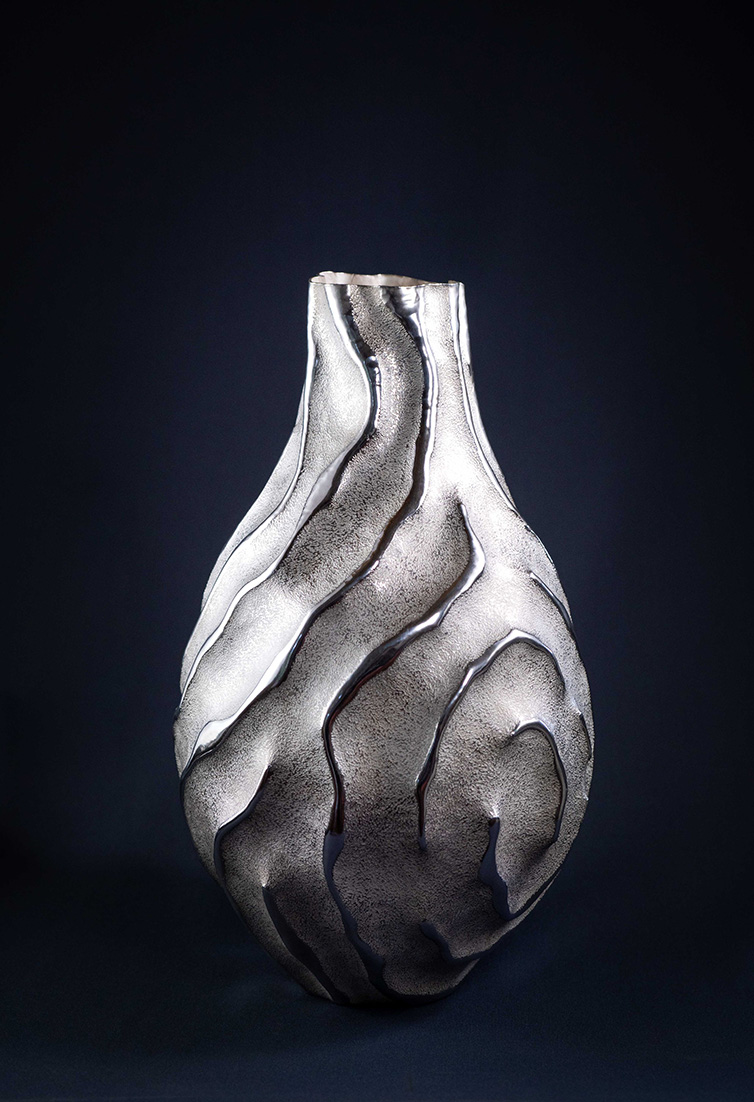
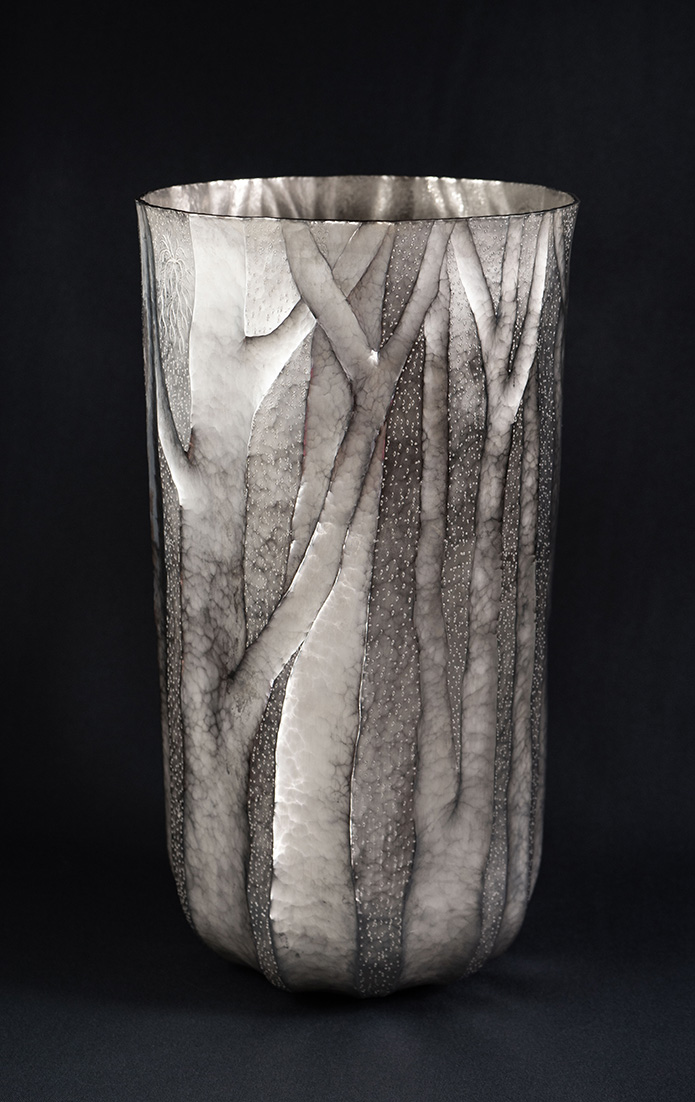
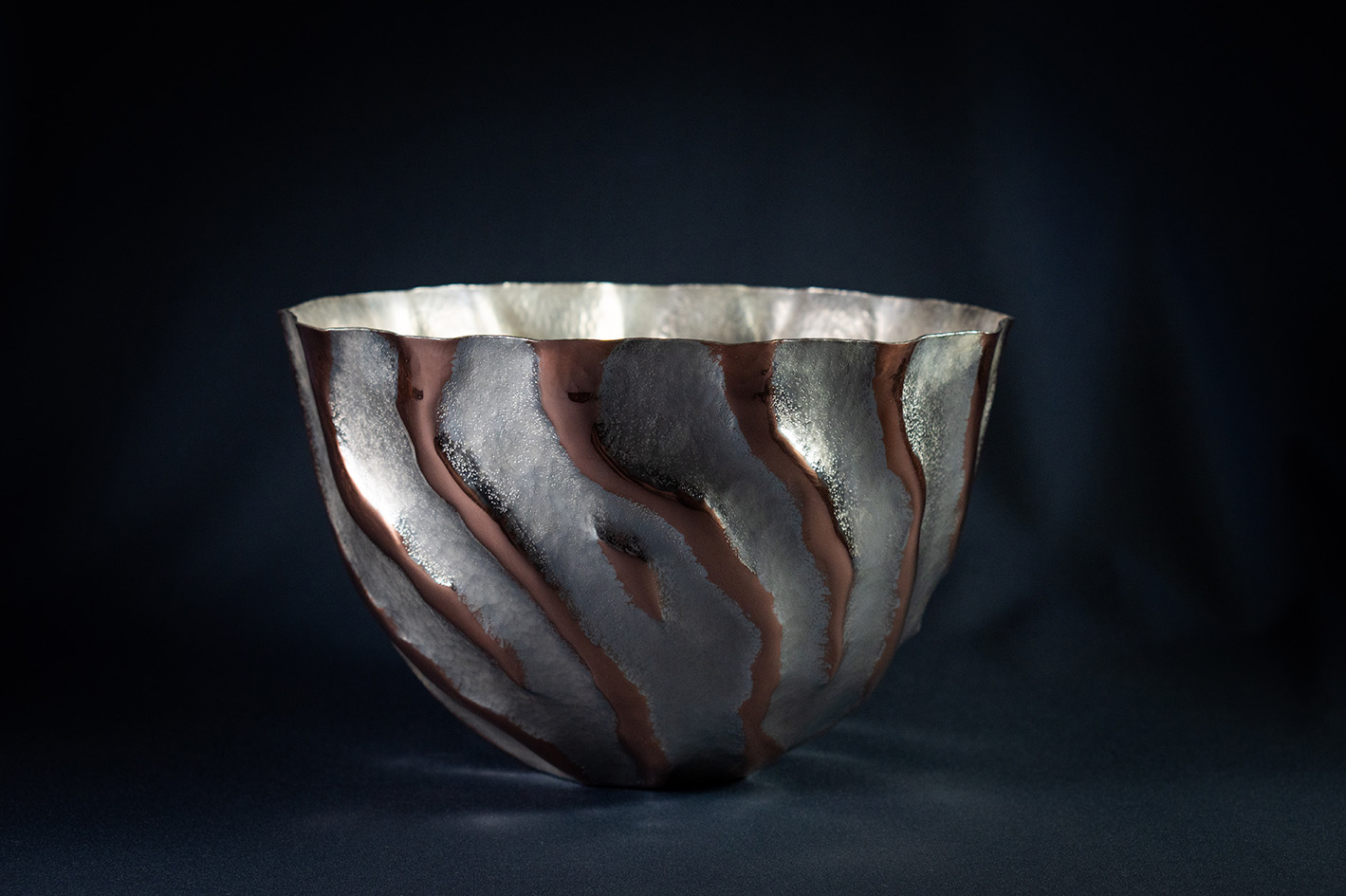
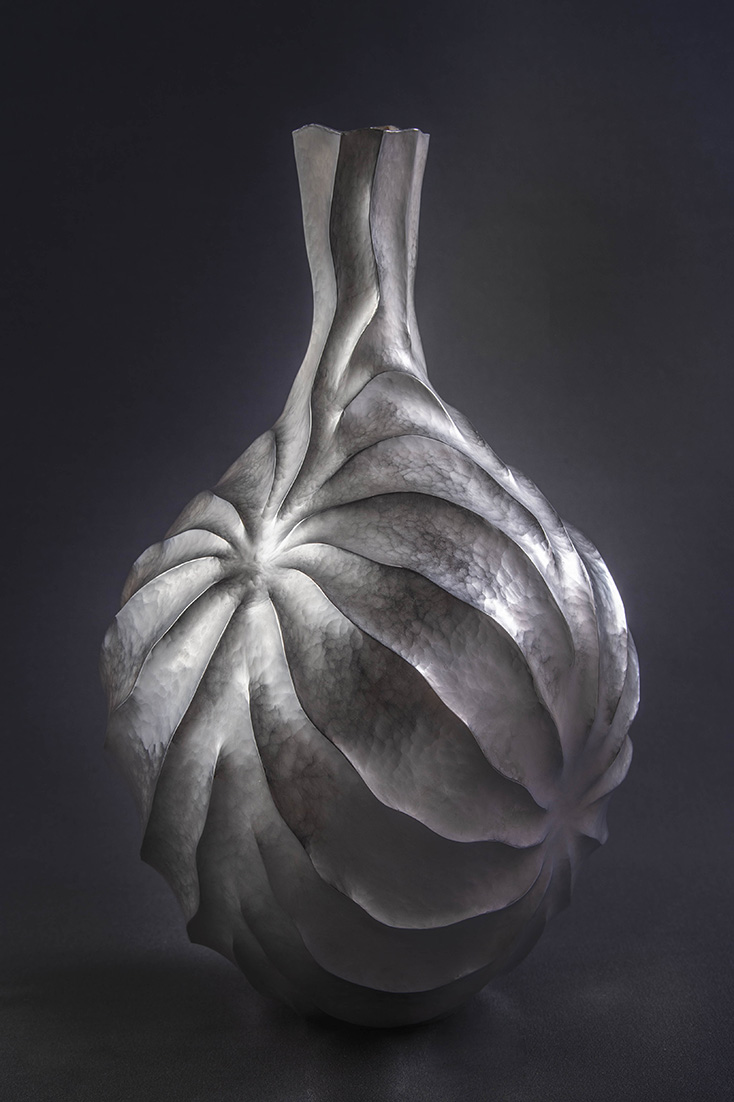
In 2015, the National Museum of Decorative Arts (MNAD), located in Buenos Aires and directed by the architect Alberto Bellucci, invited me to exhibit a type of work I had been creating for about five or six years. They did so with these words: "We have to show this work."
It consisted of vases and other fairly large containers. The exhibition, curated by Hugo Pontoriero—the institution's current director—was very well received by the public and sparked a debate among visitors that, I must admit, surprised me: craft or art? That was the dilemma.
Shortly before that exhibition, Ángeles Smart, a journalist from Bariloche, had interviewed me. The title included my name, and underneath it, the words "goldsmith and artist." I had never been called an artist before. What had changed?
Around that time, Ana María Cousillas, at the end of an exhibition of my work at the José Hernández Museum of Popular Art (MAP), which is part of the Buenos Aires City Government, decided to acquire one of my pieces and told me, "I want to add the first piece of contemporary silverware to the museum's collection."
Before this period, I had maintained a production of over 20 years within the traditional Argentine Creole style; and it was remarkable that when I began to design in a freer and more personal way, the new works generated a rich debate.
For the catalog of the exhibition held at the MNAD, Roberto Vega wrote:
"In the DNA of all craftsmanship, the craft is essential, to the point that it is not possible without it. But mastery of the technique is not enough; a deep understanding of the culture that gives rise to and contains it is also required [...]"
This cultural matrix is what "receives" each contemporary artisan with its predetermined canons and expressions. It is up to them to grow within the comfort of such aesthetic patterns, or to cast off and navigate uncharted waters, just as Emiliano did [...]
The challenge of new craftsmanship lies in designing innovative expressions that connect each creator with their time and environment.
The Céliz vases contain secrets treasured in Patagonian nature and in the alchemy of the craft, and moreover, they reveal in their innovative forms the change that defines us.
Therein lies the merit of Emiliano Céliz in these unique creations. Beautiful, his vases transcend classical forms and treasure those secrets that, in harmony with their surroundings, allow us to discover them in proportions, traces, sensations [...]
Art or crafts? Concept or craft? Function or mere pleasure? The answer lies in each person's perspective. And it will not be the definitive one, nor the only one.
From these generous insights into my work, I noticed a shift that defined it.
Incorporating artistic expression into the noble craft through design and production in harmony with the environment and time forever changed my experience as an artisan and opened the doors to the free exercise of creativity and imagination. I believe others have done the same before me, including the great master goldsmith Dámaso Arce.
In fact, craft and art are not separate.
We could say that craft is a form of production that allows for the creation of high-quality objects, which generally represent cultural identities, idiosyncrasies, regional customs, and styles.
But what happens when an artisan discovers the need to make their design more aligned with their own personal experience in their time and place? What happens when that design introduces new elements and a new language, and moreover, by the very act of producing that work, suggests a potential innovation?
Does it stray from tradition? Or could it be thought that this new work could be a valuable contribution to the tradition of a very rich craft?

Detail of the work "Pellines with Mistletoe." Author: Emiliano Celiz.
In recent years, exceptional craftsmanship has unexpectedly reached prestigious spaces in the art world. In 2022, Cecilia Alemani, curator of the 59th Venice Biennale, selected the work of Tucumán ceramist Gabriel Chaile for the central exhibition. Craftsman or artist? In my opinion, he is both a craftsman and an artist, creating a handcrafted work with artistic value. And Chaile's international career has continued unabated ever since.
I dare say that we sometimes make the mistake of trying to separate art, crafts, design, etc. Perhaps the most important thing is to safeguard, first and foremost, and then allow for the freest possible personal expressions that enrich all crafts. And to understand that this will never be detrimental to our roots and traditions.
On the contrary, encouraging the expression of contemporary and personal values gives strength and vigor to crafts, leading to diversity and, therefore, allowing them to occupy a variety of niches and environments they don't currently reach.
In my opinion, the strength of our traditional Creole style was generated by the encounter and amalgamation of diverse cultural currents. And what happens when these converge? They become a river, now with greater force and flow.
Today, good craftsmanship has the quality of providing its owner with a sense of comfort and value, related to what is good, desirable, noble, and tasteful. It expresses quality, what endures, and what has a direct connection to being made with personal attention. Furthermore, stylish pieces contain symbolic elements related to identity.
Craftsmanship awakens emotions related to the micro and macro world we want to surround us. That is the foundation of interior design.
Decoration comes from the Latin word decorum, meaning "appropriate" or "suitable." It signifies treating the place where we live with the dignity befitting its inhabitants. It is linked to well-being, self-respect, and identity, and connects us to others through a symbolic dialogue often more important than words. We need to create the right atmosphere in the places we inhabit.
The world yearns for these sensations, especially today, because we must find a counterpoint to the artificial life to which we are subjected.
It's a time of opportunity for craftsmanship.
The encounter between art and craft is necessary for the evolution of both. And to talk about art, let's use an example: imagine a theater and a stage where a pianist takes the stage, performing a piece of their own composition or one by another composer; and the audience listens, captivated by what happens through the sound, feeling something stirring within them.
Where is the artistic expression? Where does art happen? In the theater, on the stage, in the pianist, in the instrument, in the score, in the listening audience? It's in everything; art permeates it. That is its essence; art is an experience.
Let's look at another example: there's an exhibition of ceramics, or silverware, or textiles… People enter to see it, and the pieces evoke admiration, emotions, ideas… Now, focusing on a material expression, where is the art? Only in the pieces, or in the way they are displayed, in the curatorial approach, or perhaps in the catalog? It is in everything, and the works are the link between all those who participate in the experience.
The artistic experience is NOT THE WORK ITSELF, but rather a dialogue, a social and human configuration where everyone is touched by art. And the work, then, is the point of contact between everyone.
The ancient Greeks said that when someone was in a certain receptive state [one might say inspired], the muses descended and spoke in their ear, and that's how the work of art was created. Then, someone would approach that work of art and have to put themselves in that same receptive state to perceive the message, the idea, the emotion, etc.
Compared to crafts, one could say that art is more related to the existential aspect, an exploration of existence. It is a kind of perspective, a way of thinking, of expressing oneself, also a means of self-discovery, of integrating what lies beyond the rational and the concrete.
We've stated it before: craftsmanship and art are not inherently separate; they can be part of the same thing and enhance each other.
This is clearly seen in collections of silverware, textiles, ceramics, etc. The pieces that have endured are those with artistic value.
On a separate note, we mustn't confuse craft with style. Style, once chosen, is like a territory with its boundaries, a territory that can be explored, and traversed through craft.
The experience of exploring it provides knowledge and allows us to arrive at other observations and, at times, at the very limits of both style and craft. In that situation, encounters with other lives, other artisans, and other crafts can occur; and transcending those boundaries and integrating such encounters can bring forth new forces and open up greater expressive possibilities.
That's called INNOVATION. To put it in biological terms, what doesn't evolve, doesn't remain.
* Special for Hilario. Arts, Letters, Crafts