The Man
Ricardo Gregorio de Lafuente Machain, lawyer, Doctor of Jurisprudence, and historian, was born in Buenos Aires on January 4, 1882, son of Francisco de Lafuente and María Estela Machain [1]. He studied at the Faculty of Law and Social Sciences of the University of Buenos Aires [1899-1905] and graduated with a doctorate in jurisprudence with a thesis on Property Subject to Reservation, published by Valerio Abeledo in 1905.
He was a Member of the National Commission for the Conservation of Artistic and Historical Monuments of Argentina [1918], Secretary and President of the Commission for the Commemoration of the Thirty-Three Orientals [1927], Vice President of the Exhibition of Religious Art of the XXXII International Eucharistic Congress, in Buenos Aires [1933], and Treasurer and Founding Member of the Argentine Historical Society.
He was also a member of several scientific and cultural institutions in Argentina and abroad. He was a corresponding member of the Royal Academy of History and the Royal Academy of Geography, both in Madrid; the Chilean Academy of History; the Chilean Society of History and Geography; the National Academy of History and Geography, of Mexico; the National Academy of History, of Ecuador; the National Academy of History, of Venezuela; the Center for Historical Research, in Guayaquil; the Institute of Historical Studies, in Paraguay; the Royal Hispanic-American Academy of Sciences and Arts, in Cádiz; the San Luis Academy of Fine Arts, in Zaragoza; the Royal Academy of Declamation, Music and Fine Arts, in Málaga; a founding member and member of the Argentine Bibliophile Society; a member of the Ibero-American Athenaeum, the Argentine Social Museum, and the Argentine-Paraguayan Cultural Institute [2]. He also belonged to the Société des Americanistes, in Paris, and the Bar Association, in Arequipa.
Despite never holding public office, he was decorated by various governments and institutions. His distinctions included: Knight of the Legion of Honor; Commander of the Royal Order of Isabella the Catholic, Spain; Commander of the Order of the Sun, Peru; and Commander of the National Order of Merit, Paraguay [it is worth noting that in Paraguay he financed the construction of the Spanish Sanatorium, which was given to the Spanish Mutual Aid Society in 1928]. He also received the Public Instruction Medal, Venezuela.
He married Clemencia Sáenz Valiente, with whom he had two sons: Hernán Ricardo and Ramiro Ricardo [3].
The Historian
Naturally inclined toward academic disciplines, he dedicated himself from an early age to historical biography and genealogy.
He traveled extensively to Europe and visited Chile and Paraguay in the Americas. Always committed to his vocation as a meticulous and tireless researcher, he consulted the most important private and official archives in every country he visited, gaining a unique understanding of many little-known episodes and figures in American and Spanish history. This work allowed him to write, over more than 30 years, works of considerable merit, in which historical events are viewed from unexpected perspectives.
His first historical work was *The Image of the Patron Saint of the Assumption*, published in Buenos Aires in 1917. This was followed by many volumes that alternated between historiographical topics related to figures such as Rosas, Pueyrredón, and Alonso Riquelme de Guzmán, and to places in the city of Buenos Aires.
In chronological order, his work comprises books, pamphlets, and articles: The Patron Saint Image of the Assumption [1917]; The Machain Family [1926]; American Antecedents of the Primo de Rivera Family [1927]; The Saavedra Family During the Colonial Period [1929]; The Sáenz Valiente and Aguirre Families [1929]; The Founding Process of the Assumption [1930]; The Portuguese in Buenos Aires, 17th Century [1931]; Irala [1932]; The Relatives of Blessed Roque González de Santa Cruz [1934]; The Port of Santa María del Buen Aire and the City of La Trinidad [1935]; Don Pedro de Mendoza and the Port of Buenos Aires [1936]; The Fortified House of the Assumption [1936]; The Gates of the Land [1936]; Conquerors of the Río de la Plata [1937]; Ephemeral Settlements [1937]; Governor Domingo Martínez de Irala [1939]; Rosas and the Salvá Dictionary [1940]; Pueyrredon Seen Through a Letter Copyist [1940]; The Virgin of the Assumption and Her Oratory [1940]; The Asunción of Yesteryear [1941]; The Lafuente Family [1941]; Alonso Riquelme de Guzmán [1942]; Death and Exhumation of the Supreme Perpetual Dictator of Paraguay [1943]; Buenos Aires in the 17th Century [1944]; The Recoleta Neighborhood [1945]; Enrique Lafuente [1946]; Buenos Aires in the 18th Century [1946].
Formation of the Collection
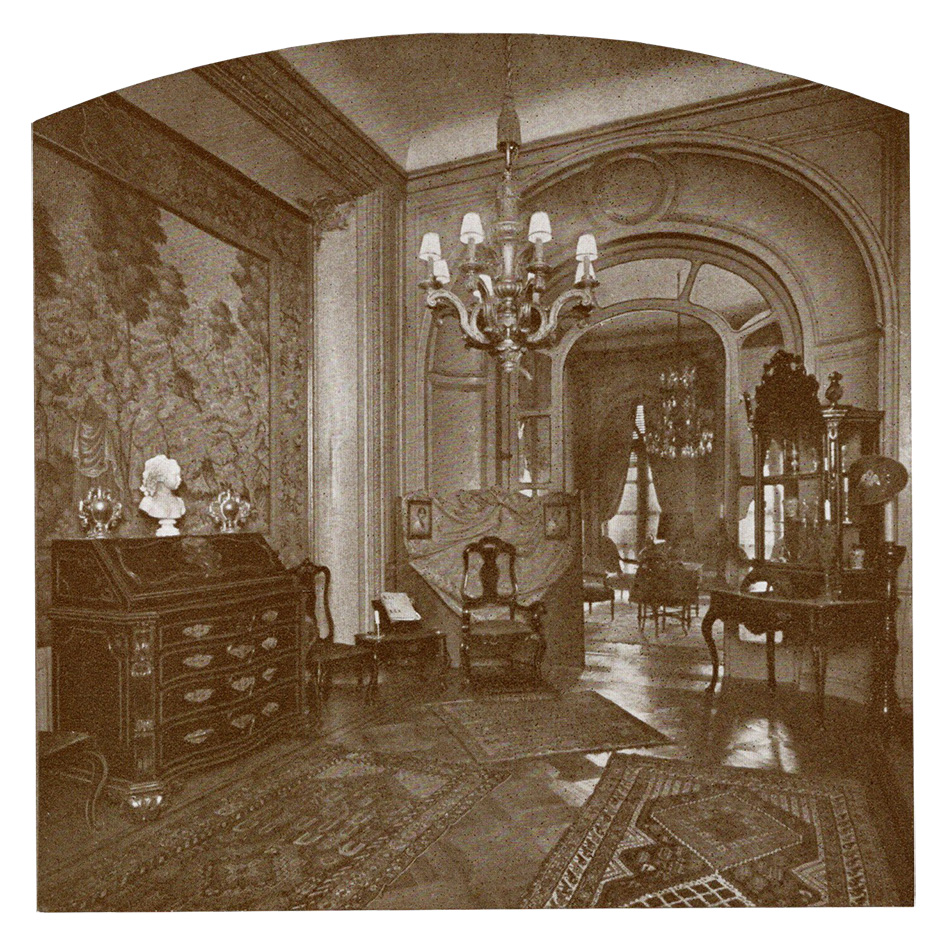
Lafuente organized his library in the mansion where he lived, at Guido 1845 between Ayacucho and Callao [4], which was a museum of Jesuit and Luso-Brazilian colonial art and furniture. The library, comprising some 4,000 to 5,000 volumes, was rich in chroniclers and travelers, Romantic literature—including Echeverría in his first editions—and printed works from the Banda Oriental (present-day Uruguay) and Chile. It also included documentary, genealogical, and heraldic collections. In 1933, he participated in the Spanish Book Exhibition in Buenos Aires [5]. He owned the collection of works printed by the Argentine Bibliophile Society, of which he was a founding member in 1928. His own books were meticulously produced, with the details characteristic of works typically intended for bibliophiles.
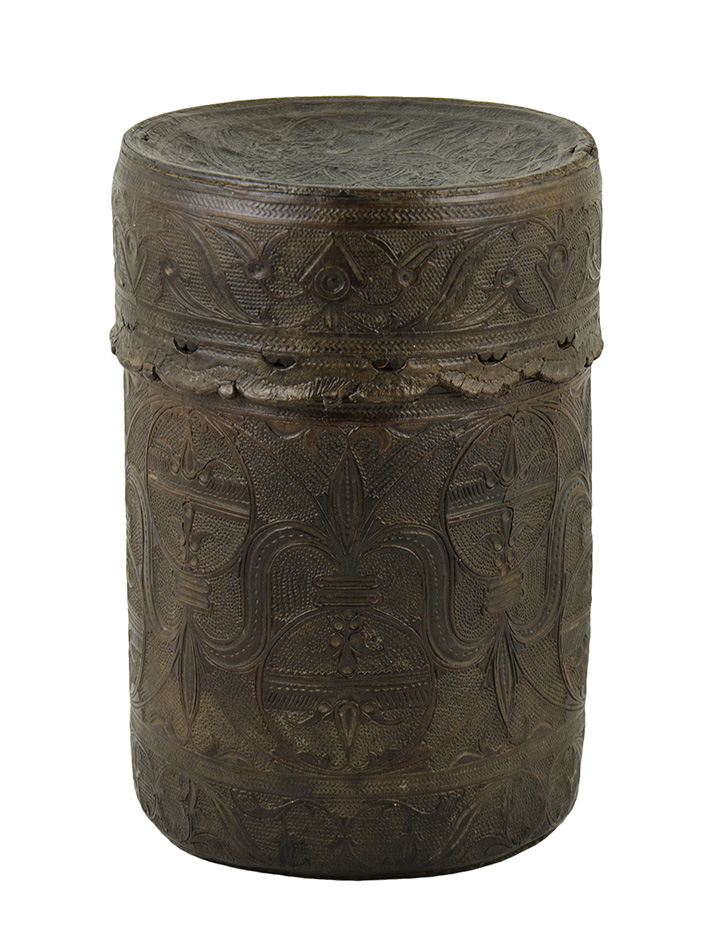
He also amassed valuable manuscripts. In this regard, he acquired and rescued important historical documents from the Paraguayan José Doroteo Bareiro, paleographer and director of the National Archives of Asunción, whom Lafuente Machain publicly honored in the prologues to his works. Bareiro spent more than forty years reviewing and transcribing thousands of documents from the era of Gaspar Rodríguez de Francia and Carlos Antonio López [6].
Bookplate
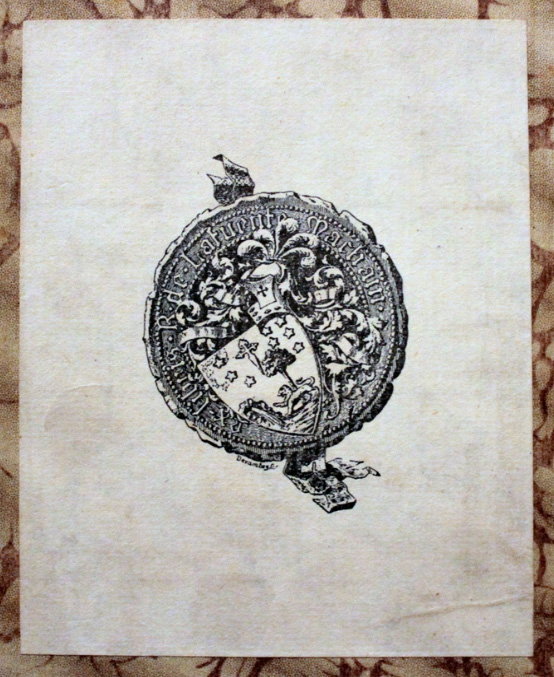
Lafuente Machain had his bookplate printed at the Devanbez printing house in Paris.
Édouard Devambez [1844-1923] was an artist described in Bénézit's dictionary as a bookplate engraver. In 1873, he acquired the printing house founded in 1826 by the royal engraver Hippolyte Brasseux. Known as Maison Devambez, the company initially specialized in heraldic engravings, engraved letterheads, and invitations, counting among its clients the Houses of Orléans and Bonaparte, as well as the Élysée Palace. It later expanded its business to include advertising, artists' engravings, luxurious limited-edition books, and a prominent art gallery. It was one of the most prominent printing houses in Paris and received numerous medals and awards at the Universal Expositions in Paris in 1878 and 1889. After the First World War, with the artist Édouard Chimot, it published a series of limited-edition art books that employed leading French artists [Picasso, Modigliani], illustrators, and poster artists. This series reached its zenith under the imprimatur "A l'Enseigne du Masque d'Or" (The Sign of the Golden Mask) and with "PAN" [Annuaire du Luxe à Paris], a luxurious yearbook published in 1928 in collaboration with the famous French haute couture designer Paul Poiret. "PAN" compiled 115 artistic advertisements in the Art Deco style for leading Parisian luxury brands such as Hermès, Lanvin, and Van Cleef & Arpels, illustrated by influential artists like Jean Cocteau and Foujita.
The printing house and publishing house was famous for its exquisite engravings on metal, wood, and stone. Its bookplates and bibliographic seals were characterized by the use of steel and copper engraving techniques, as well as stamping and lithography. They frequently used combinations of different ink colors to highlight heraldic, typographic, or allegorical details. Devanbez's approach guaranteed a level of precision down to the millimeter, ensuring that the design adhered to traditional rules of size and proportion. The house had its own catalog. In 1910, the house published the book Monogrammes, Cachets, Marques, Ex-libris by the artist Eugène Belville, a practitioner of Art Nouveau and Art Deco [7]. This work documented the intricate design and composition techniques of monograms and heraldic seals used by bibliophiles of the time [8].
It remains to mention that André Victor Édouard Devambez, Édouard's son, was born in 1867. He became a renowned painter, engraver, and illustrator after receiving the Prix de Rome, was a member of the Academy of Fine Arts, and a Commander of the Legion of Honor. He died at his home in Paris in March 1944 at the age of 76. He left behind a large number of works in the world's finest museums. One of his great paintings is La Place Pigalle [July 14th in Pigalle Square], from 1906, which is housed in the National Museum of Fine Arts in Buenos Aires. From the top of a hotel, it depicts the urban spectacle of the Bastille Day celebrations. There are men, women, children, attractions, carousels, and even an impromptu Greco-Roman wrestling ring. Tricolor flags wave from balconies. Horse-drawn carriages mingle with gleaming automobiles. The result is a chaos not without its own beauty, which has been analyzed by researcher María Isabel Baldasarre. André's work was honored with a major exhibition held at the Petit Palais in September 2022.
Fate of the Collection
Ricardo de Lafuente was rather short, bald, with a slightly nasal voice, and a bright gaze behind his glasses. Sober and natural in his dress, without any affectation, he wore his white shirts of ahó-poy, the Guaraní name for a type of domestic cotton fabric that he had brought from Paraguay, in contrast to his ever-present black bow tie.
After many years of intellectual production, he spent his life in the refuge of his select library and, after a long illness, died at his home in Buenos Aires at the age of 78 on March 10, 1960 [9]. Upon his death, his bibliographic, artistic, and archival holdings were entrusted to his son Ramiro, and upon Ramiro's passing, his granddaughter, Inés de Lafuente [1944-2015], became the custodian of the library and documents amassed by her grandfather. The collected furniture was dispersed through various auctions in Buenos Aires.
Notes.
1] Carlos Calvo, Nobiliario del antiguo Virreinato del Río de la Plata, Volume IV, Buenos Aires, Librería y Editorial «La Facultad», 1939, p. 39.
2] In the session of April 26, 1960, Academician Dr. Enrique Ruiz Guiñazú proposed that the National Academy of History pay tribute to the recently deceased historian Ricardo de Lafuente Machain, and on that occasion stated that Dr. de Lafuente Machain, “perhaps due to those strange circumstances that no one can explain, did not belong to our Academy, despite the merit of his work and the profound reverence he always showed for the Argentine tradition, of which he himself was one of the exponents” [See: “Homage to the historian Ricardo de Lafuente Machain,” in Boletín de la Academia Nacional de la Historia, Year XXXVII, No. XXXI, Buenos Aires, 1961, pp. [73-74] We also don't know why he was never interested in joining the Argentine Institute of Genealogical Sciences. Perhaps he didn't feel comfortable in those institutions but did in others, such as the Argentine Historical Society.
3] Hernán Ricardo [1913-1981] married Maria Amalia Sara Lacroze Reyes Oribe [1921-2012], and they were the parents of María Inés (1944-2015). Ramiro Ricardo [1921-1995] married Gloria Josefina Castaño Urdinarrain [1928-2011], and they had six children. Ramiro, a doctor of jurisprudence and author of Patronage and Concordat in Argentina [1957], was known for his role as an administrator of film censorship during the 1970s. The library of the "Santo Toribio de Mogrovejo" Faculty of Canon Law at the Catholic University of Argentina (UCA) is named after him.
4] José Pérez Valiente de Moctezuma, “The House of the Lords of Lafuente-Sáenz Valiente,” in Plus Ultra no. 18, Buenos Aires, 1917.
5] The Art Book in Spain. Catalogue of a Selection of Spanish Books, Antique and Modern, Presented at the Spanish Book Exhibition in Buenos Aires. Preceded by Historical Notes on the Evolution of the Art Book in Spain and a Study on Argentine Bibliophiles, Madrid, 1933. 95 pp.
6] The documents transcribed by Bareiro [formally known as the José Doroteo Bareiro Collection] underwent a long and complicated journey due to political instability. Although the Paraguayan State initially financed these typed transcriptions for publication, the documents eventually disappeared from the public archive. Certain copies passed into private hands and into exile. Decades later, they were located in the personal library of former Paraguayan President Juan Natalicio González in Mexico, before being recovered and returned to the National Archives of Asunción.
7] Monogrammes, cachets, marques, ex libris, Paris, Devambez, 1910. Of this unpaginated work with 53 plates, 20 copies were printed on Japanese paper, numbered 1 to 20, and 500 copies on Holland paper, numbered.
8] The Devambez company [16 Place Vendôme, Paris] has redefined its role in contemporary society by manufacturing luxury or high-end paper products with its original watermark [its exclusive line of rolling papers is especially well-known] and providing publishing services. Its catalog is sold in select boutiques.
9] “Ricardo de Lafuente Machain. His Funeral,” in La Prensa, no. 30,918, Buenos Aires, March 12, 1960. In La Nación No. 31,801 of March 11, 1960, an obituary for Ricardo de Lafuente was published, announcing his passing through the offices of his wife, Clemencia Sáenz Valiente de Lafuente Machain, his sons Hernán R. and Ramiro R., his daughter-in-law Gloria Castaño de Lafuente, and his grandchildren Inés, Gloria, María, and Ignacio José.
* Special for Hilario. Arts, Letters, Crafts